Forskrift om brannforebygging §12 · Updated October 2026
Online fire safety course for all employees
Learn how fire starts, how to prevent it, how to use extinguishers and evacuate safely, and what the law actually requires. Verifiable certificate the same day you pass.
- Duration
- about 60 minutes
- Language
- Norwegian & English
- Kursbevis
- Yes, included
- Price
- NOK 990 per seat
The whole course is free to take. No account needed to start. After you pass the exam you get your certificate through the course.
Certificate · Fire safety
HMS-2026-000481
Awarded to
Kari Nordmann
Employee · Eksempelbedrift AS · Trondheim
Issued
23 April 2026
Exam
96 % (70 % pass mark)
Scan to verify, or visit
hmslederkurs.no/kursbevis/eksempel
Sample certificate. Real format, fictional name. Open the full version.
In short
A business that uses a building must have routines that make sure everyone who works there has sufficient knowledge and skills to prevent and fight fire, and routines for evacuation and rescue (fire prevention regulation section 12 letters b and c). DSB writes in its guidance on section 12 that fire drills and training must be held for all employees, scaled to the risk, and the requirement for a dedicated fire safety manager was removed with the 2016 regulation. This fire safety course gives the general training in about 60 minutes, with a certificate the same day you pass. Knowledge of your own building (escape routes, alarm, extinguishers and fire instructions) is given locally, together with the extinguishing and evacuation drill at the workplace.
- Who
- Everyone who works in the building, and managers responsible for fire safety
- Legal basis
- Forskrift om brannforebygging §12
- Last updated
Free to take
pay NOK 990 when you pass
about 60 minutes
done in one sitting
Real people
answer when you have a question
Same day
certificate in inbox
How you get it done
Three steps. No classroom, no travel time.
Start for free
Press start and the course opens in your browser. No payment, no account, no install. If you want to pause and continue on another device, you can leave your email along the way. Questions? A human replies by email as soon as we can.
Take the course at your own pace
Six lessons cover the chain of duties, how fire starts and spreads, prevention, extinguishing equipment, escape and documentation. Each lesson ends with a short quiz, and the course can be finished in around 60 minutes on mobile or desktop.
Pay at the end and get your certificate
Once you pass, you pay and your certificate is issued right away. You pay by card, and companies can get an invoice against their org number on request. A numbered, QR-verified PDF is sent to your email the same day, ready to attach to a reply to an order or file in the HR folder.
Fire safety that holds up when it matters.
Prevention, extinguishing and evacuation. The course gives the general training in fire safety, with a certificate. Knowledge of your own building and the drill are given locally.
See for yourself
Contents: prevention, extinguishing and evacuation
See what the course covers before you start. The content is built on the Fire and Explosion Prevention Act, the fire prevention regulation and the Working Environment Act, with sources to lovdata and DSB in every lesson.
- A lovdata link in every module, so you can verify every claim
- Skim-reading is fine, no time gates on pages
- A short knowledge check at the end of every module
6 modules in the course
Each module links directly to lovdata.no and DSB and the fire-and-rescue authorities' guidance.
How the course is built. Open a module to see what it covers and which statutory provisions it rests on.
01Why fire safety, and what the law actually requires
The module sets out the chain of duties: everyone has a duty of care under the Fire and Explosion Prevention Act section 5, the owner must make sure fire safety equipment is inspected and maintained (fire prevention regulation section 5), and the business using the building must have routines for evacuation and for employees being able to prevent and fight fire (section 12). You learn that the requirement for a dedicated fire safety manager was removed with the 2016 regulation, and that inspections are normally carried out by the municipal fire and rescue service.
Legal basis:brann- og eksplosjonsvernloven §5forskrift om brannforebygging §5forskrift om brannforebygging §12DSB: ofte stilte spørsmål om forskriften
02How fire starts and spreads
The fire triangle, heat, fuel and oxygen, explains both prevention and extinguishing: remove one of them and the fire goes out. You learn the most common causes at workplaces, especially electrical faults and kitchens, how a fire can reach flashover within minutes, and why smoke and fire gases are more dangerous than the flames. The module ends with fire classes A, B, C, D and F, which decide the right extinguishing agent.
03Prevention in the workplace
Much of prevention is in your own hands: tidiness, safe battery charging, correct use of extension leads and clear escape routes, which whoever uses the building must ensure under fire prevention regulation section 11. You learn what smoke detectors, sprinklers, fire doors and emergency lighting do, that they must never be disabled, and that faults are reported to the owner, who must inspect and maintain them (section 5). Hot work such as welding and grinding is not covered by this course.
Legal basis:forskrift om brannforebygging §11forskrift om brannforebygging §5
04Extinguishing equipment and first response
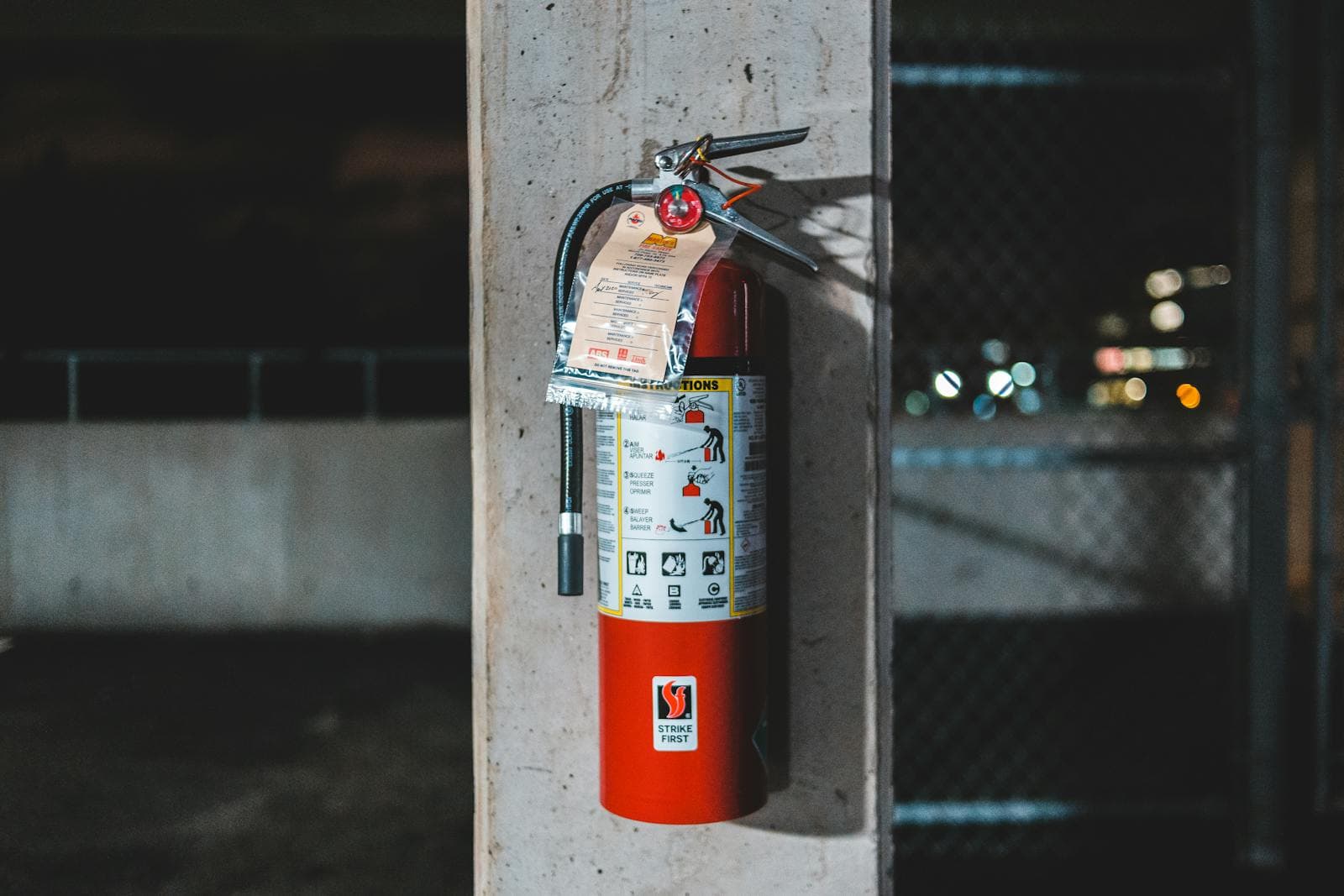
You learn which extinguishing agent suits which fire class (powder, CO2, foam and fire blanket) and four steps for a handheld extinguisher: pull the pin, aim at the base of the flames, squeeze and sweep, always with the escape route behind you. The order is rescue, alert, extinguish, and smoke or a fire bigger than a waste bin means evacuate, not fight. The hands-on drill with a real extinguisher must be done at the workplace, because Working Environment Act section 3-2 requires both training and practice.
Legal basis:brann- og eksplosjonsvernloven §5aml §3-2
05Escape and evacuation
The module is about knowing the building before it burns: both escape routes, the nearest manual call point and the assembly point. When the alarm sounds, you call 110, evacuate calmly, help others, close doors and never use the lift, and in smoke you stay low. The business must have routines for evacuation and rescue (fire prevention regulation section 12 letter b), with roles assigned in advance and separate plans for people who need help to get out.
Legal basis:forskrift om brannforebygging §12forskrift om brannforebygging §11
06Tasks, drills and documentation
The last module ties knowledge to drills and documentation: DSB's guidance on section 12 says fire drills and training must be held for all employees, scaled to the risk, and the business using the building must be able to document that its duties are met (fire prevention regulation section 13). You go through what a fire instruction should contain, what applies to special fire objects the municipality keeps a register of (Fire and Explosion Prevention Act section 13), and employees' own duty to contribute to safety (section 25).
Legal basis:DSB: veiledning til forskrift om brannforebyggingforskrift om brannforebygging §13brann- og eksplosjonsvernloven §13brann- og eksplosjonsvernloven §25
Legal basis and sources
The course is built on these sources. The links go to the statute or to the supervisory authority's own guidance, so you can read the requirement yourself.
- Forskrift om brannforebygging §12
The business using the building must have routines for evacuation and rescue, for making sure people who work there can prevent and fight fire, and for informing everyone present.
- Forskrift om brannforebygging §11
Whoever uses the building must avoid unnecessary fire risk, keep escape routes passable and report damage and defects to the owner.
- Forskrift om brannforebygging §13
The business using the building must document that its duties under sections 11 and 12 are met, training included.
- Brann- og eksplosjonsvernloven §5
Everyone must take ordinary care, raise the alarm in a fire and limit the damage as far as they are able.
- Brann- og eksplosjonsvernloven §8
Businesses must run internal control, and compliance must be documentable to the supervisory authorities.
- Arbeidsmiljøloven §3-2
The employer must give the training, practice and instruction that is necessary.
- DSB: veiledning til forskrift om brannforebygging
The guidance on section 12 says fire drills and training must be held for all employees, with scope and number of drills adapted to the building.
- DSB: ofte stilte spørsmål om forskriften
The requirement for a dedicated fire safety manager has been removed; the owner is still responsible for fire safety.
Your certificate, same day
A quick, documented path to your certificate.
You take the course, pass the exam, and have a numbered, QR-verified certificate in your inbox the same day. Ready to show DSB or the fire and rescue service, HR, or an auditor.
Pass it in the same session
You take the exam right after the last lesson, see the result immediately, and can retry free if you fail. No examiner queue, no waiting for post. 70 % pass mark.
Questions along the way? We answer
If something is unclear while you take the course, send us a message right from the course. A real person reads it and answers as soon as we can.
QR-verified in seconds
Every certificate has a unique number (HMS-YYYY-NNNNNN) and a QR code. HR, an auditor or DSB or the fire and rescue service can scan and confirm it directly against our register.
Grounded in law, kept current
Every module links directly to lovdata and DSB and the fire-and-rescue authorities' guidance, so you can verify every claim yourself. Updated whenever the regulations change.
Who wrote this course
The course is developed and maintained in-house by HMS Lederkurs, grounded in current law and regulation and DSB and the fire-and-rescue authorities' guidance.
Every lesson links directly to lovdata.no and DSB and the fire-and-rescue authorities' guidance, so you can verify every claim yourself. The content is updated when the rules change. The certificate documents the completed training, its content and its legal basis.
This is what your certificate looks like
Numbered HMS-2026-NNNNNN. QR-verified. Send it to your employer, HR or DSB or the fire and rescue service. They can scan and confirm it directly against our register.
Open the example certificatePrice
Start free, pay when you pass
No upfront payment. You pay only after you have taken the course and passed the exam.
NOK990
Free to take. You pay when you pass. No VAT (mval §3-5)
- The whole course and exam are free to take
- Certificate with QR verification, pay only when you pass
- Real people answer your questions along the way
- Free retake if you fail
The whole course is free to take. No account needed to start. After you pass the exam you get your certificate through the course.
Volume discount for companies
Published prices, no negotiation rounds.
- 1 seat
- NOK 990per seat
- 5+ seats
- NOK 790per seat
- 20+ seats
- NOK 590per seat
- 100+ seats
- Contact us
Org-number invoicing for 5+ seats, EHF on request. See team setup →
Frequently asked questions
Is this a statutory fire-safety-manager course?
No. The requirement for special fire objects to have a dedicated fire safety manager was removed when the fire prevention regulation replaced the 2002 regulation from 1 January 2016, and DSB writes that the owner is still responsible for fire safety. The course gives the general training in fire safety, documented with a certificate. Knowledge of your own building and the skills come in addition and are given and practised locally, as part of the business's own routines under fire prevention regulation section 12 letter c and Working Environment Act section 3-2.
Does the course cover the physical extinguishing and evacuation drill?
The course gives the general training in fire safety. Knowledge of your own building (escape routes, alarm, extinguishers, fire instructions) and the physical extinguishing and evacuation drill with real equipment must be given locally at the workplace. The lesson on tasks, drills and documentation includes a ready-made checklist the organisation can use to run and document the practical drill.
How often must I renew my fire-safety knowledge?
There is no fixed statutory interval for ordinary employees. Regular refresher, preferably yearly together with the local fire drill, is a recommendation and not a legal requirement. Special fire objects have stricter requirements.
How does the certificate document the training?
The certificate is numbered and can be verified with a QR code, and it shows that the general training is complete, what it contained and its legal basis. Together with a dated log of the local drill, it gives the business a clear record to show at an inspection by the fire and rescue service. The business using the building must document that its duties under sections 11 and 12 are met (fire prevention regulation section 13), and internal control must be documentable to the supervisory authorities (Fire and Explosion Prevention Act section 8).
Who needs fire safety training?
Everyone who works in the building. Fire prevention regulation section 12 letter c requires routines making sure people who work in the building have sufficient knowledge and skills to prevent and fight fire, and letter d requires everyone present to be told how to avoid fire and act in a fire. DSB writes in its guidance that fire drills and training must be held for all employees. The duty lies with the business using the building, and it must be documentable (section 13).
Read more (in Norwegian): fire safety training requirements →
Is an online fire safety course enough?
For the general training, yes. Fire prevention regulation section 12 requires employees to have sufficient knowledge and skills, not a particular course format. Knowledge of your own building (escape routes, alarm, extinguishers and fire instructions) has to be given locally, and the skills part has to be practised physically: DSB writes in its guidance that fire drills must be held, and Working Environment Act section 3-2 requires both training and practice. The online course plus a local walkthrough of the building and a documented extinguishing and evacuation drill at the workplace therefore gives you a record for both parts.
Also read (in Norwegian): how often is fire safety training needed? →
Putting the whole team through?
Published volume discount from 5 seats, card payment and invoice against org number on request. HR dashboard for progress tracking and bulk certificate downloads.
Background reading
Background reading on what the law requires, before you start.
How often must staff have fire-safety training?
No fixed interval, but the law requires adequate, documented training and the drills that are needed.
Fire-safety training requirements for businesses
What the law requires in knowledge, drills and documentation.
How to document HMS training (with an example certificate)
Field by field: what the certificate must contain, where to file it, and how verification works.
Other courses in the catalogue
Related courses for the same workplace.
Start the fire-safety course for free, pay only when you pass
Start for free, take the whole course, and pay only once you have passed. If you fail, you can try again at no extra cost.
Updated 2026 · VAT-exempt (mval §3-5) · Lovdata-linked in every topic
Tell us what you think
When you have finished, we appreciate an honest Trustpilot review, so the next participant knows what to expect.